Sunday, August 22, 2010

Is my Halo Showing?


The last few weeks have pushed me into a world of board meetings, coffee shops, homeless shelters, sport coats, frisbees, commentaries, and Facebook. Life as a pastor--and particularly a college pastor--is so filled with otherwise utterly unconnectable elements, that at the end of the day I sometimes wonder if I've worn out my mental clutch from changing gears so rapidly. A typical day consists of an in-depth study of Hebrew poetry punctuated by interactions with people requesting financial assistance, staff meetings, and conversations with students about auto mechanics, recent movies, and their favorite preachers.

A few highlights of the job so far:
* A special budget for buying coffee with students
* Clergy parking spaces at the hospital (see picture above--and yes, I did go out of my way in the parking deck just so I could use one!)
* Getting to read Greek and Hebrew as part of my job
* Antics with my roommates

Thursday, July 29, 2010

Next Stop: Wheaton


Several days into my new life in Wheaton, I'm quite pleased with my new house and housemates, I'm excited about my new church, and I can't wait to get started on my job on Sunday. Yet, I'm also finding that adjusting to life here in Wheaton is taking at least as much, if not more effort than adjusting to any of the places I visited in Japan. Maybe it's because I expected to be a foreigner there. Or maybe because I knew I was leaving again soon. Regardless, the prospect of entering into a new place, forming new relationships, even adapting to a new culture, is somewhat daunting.

Below is a poem I wrote along these lines. The form is a modified quatrina--the four lines of each stanza end in the same four words, like themes, though their place is shifted each time. I found the constant movement and the discordant familiarity of the repetition reminiscent of the feelings of moving to a new place.


"So this is home now"

So this is home now:
re-paint what were another's walls,
enclose in them my things and then call "home"
where moments ago was only "here."

My posters there, my favorite mug goes here,
old textbooks stacked (they seem less urgent now).
My life a mosaic of former homes
like the farrago of photos hanging on the walls.

Outside hang other lives on other walls
who lay a longer, stronger claim to here.
Our paths, though separate, intersect us now,
though for the traveler, any "here" is home.

Yet I, though foreign, may be most at home,
who still must learn this city's unseen walls.
Another language, culture to learn now,
in homelessness I make my home here.

For where is home but where God puts me now
and the jasper walls I'll find when I leave here?

Wednesday, July 21, 2010

From Russia, with Growth


In cleaning out my closet this week, I found a box of souvenirs, photographs, and a journal from a two-week missions trip I took to Russia in high school. Having just returned from a month-long trip to Japan, I couldn't help but not some interesting contrasts:

· We used film cameras back then! And instead of just tagging people on Facebook, we made duplicates to give to our friends. I even paid extra to have all my photos scanned onto a floppy disk (now completely useless since I don't have a floppy drive!)

· Wow. I actually went out in public with hair and clothes like that.

· Ten years of ministry, life experiences, and theological education has paid off, giving me far more opportunities than I thought possible.

· It's interesting to note that in my journal I struggled with how this missions trip felt more like a vacation. On the other hand, my recent trip to Japan was purely personal but felt more like missions than anything I've done in years. I think the major difference is the relationships I've formed in Japan. (The Russia trips also became much more fruitful in later years as relationships developed.)

· My sense of humor has not matured much.

· Then, as now, the Holy Spirit does what he wills, and it is his presence that makes ministry fruitful. On both trips I noted that the things I thought I had to offer, whether teaching or preaching or evangelistic dramas, were not the things that people most appreciated. While they were glad for what I had to say, it was things like attitude, personal testimony, and a willingness to listen and pray—in short, the day-to-do workings of the Holy Spirit in our lives, which we have little conscious control over—that really reached people.


Thursday, July 1, 2010

Waiting, Sadness, Joy – Three Movements on Place


First Movement: Waiting
I’m out of Japan, but only by a few feet, sitting in the no-man’s-land of an empty terminal, unable to physically leave the country, but equally unable to legally reenter it. This trip to Japan was only possible thanks to God’s provision in opening a way for me to fly cheaply on standby. The only catch is that on days like today when all the planes are full, I have to go back and try again another day. However, because I legally left the country when my passport was stamped at immigration, it’s not as simple as just leaving the airport to go back to the place where I’m staying. Canceling my departure stamp should be an easy enough process, even here in the country of red tape, but apparently one of our number (there are several of us stranded here) never technically entered the country (there’s no entry stamp in his passport). All of us are perplexed at how he managed to leave if he never came. And more to the point, what harm there is in letting him back into a place he obviously couldn’t have left, having never been in (or so they say) in the first place. This dizzying logic has bottlenecked the system, leaving me in international limbo with nothing but a laptop and my thoughts. The interesting dilemma of the situation is that while physically I’m in a very real place (Gate 31, on the fourth floor of the south wing of an airport just outside of the city of Narita on the island of Honshu in Japan) legally, I’m nowhere—not in Japan anymore, but certainly not back in the States.

Second Movement: Sadness
While I have heard spiritual warfare described in terms of a sense of oppression or a foreboding of evil, what I have sensed here in Japan regarding dark spirits is just that: darkness. While they are oppressive against the gospel and bent on the destruction of all that God loves, they do so enshrouded in darkness, hiding even their own existence, and from darkness they blind the eyes and numb the hearts of the people. I have sensed this in various places around the country, but I am coming to sense it most strongly in the temples and shrines. Some of these ancient sites have been under the control of demonic powers for well over a thousand years, and there is great spiritual darkness there. Two days ago I visited Asakusa-jingu, another famous shrine, with my former Japanese tutor, and I began to feel an inkling of this darkness, like a passing shadow over my own spirit. It was not hostility as such, or evil, but simply numbness: the kind of numbness that brings thousands of Japanese to these sacred sites to perform rituals they themselves barely believe in, without stopping to ask why. As we walked through the grounds of the shrine, I found myself praying under my breath, reclaiming that territory for God in the name of Jesus. In the transience of our modern culture, we have come to forget the importance of place, yet I am becoming increasingly convinced that a real geographic place—an island nation in the middle of the Pacific, a hilltop just north of Tokyo, a tiny church in a rice field in Okayama—can become a locus of spiritual power. As we read the Bible, both Old and New Testaments, we do in fact see that God himself is intimately concerned with geography.

Third Movement: Joy
That same evening, I met with three dear sisters and brothers in the Lord for dinner. The four of us represent four different countries (Japan, Korea, Taiwan, and the US), yet the Lord brought us together at a tiny church in rural Japan four years ago, and then allowed us a reunion here in Tokyo. As we shared together what God had done for us over the past four years, and then prayed for his continued guidance and provision as we again go our separate ways, I was given a strong sense of a spiritual power that transcends geography. As one of my friends prayed, though we are each going separate directions, we are following the same God, and we are bound together by his love. Or as the Psalmist put it: “Even if I settle on the far side of the sea, you are there.” We serve a God who transcends geographical limitations, and his truth and love are universally imminent.

Coda: Hope
We live in a world of place and time, geography and history, flesh and blood. And in the mystery of God’s economy of the universe, what happens here in the material world truly matters in the spiritual world. Places matter to God, and to the other spirits, because they matter to us, and we are missing out on a blessing when we fail to recognize the spiritual atmosphere of places, whether a church sanctuary or a city street where we pray on the way to work. Yet, as important as location is, its value is determined by a higher authority. The south wing of Narita Airport is only Japan if my passport is stamped by the government. The hilltop of Asakusa is only dark because there, as in places all around the world, mankind has exchanged the glory of God for a lie. Someday even that hilltop will be bathed in radiant light, for a higher authority yet will claim it for himself. Thus, as I am pulled away from my brothers and sisters here to return to the US, I am joyful. Not because the 6,000 miles of earth and sea don’t matter, or the places we will go are unimportant, but because they are very important, and the God whose love echoes from the mountains of Japan to the plains of Illinois goes with each of us and binds us together. We live in a world in which every inch of rock and sea proclaims the glory of God, and Christ plays from a thousand places. And we live in the hope that even the dark places have been reclaimed as Christ’s in his death, and will be fully revealed as his in his return, for even the darkness is as light to him.

Wednesday, June 23, 2010

Interesting Sleeping Arrangements

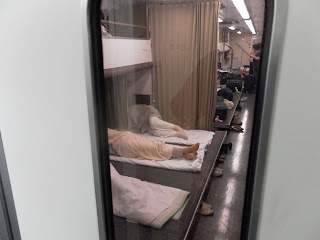
While some my find sleeping on a straw mat on the second story of a scary old Japanese farmhouse unusual accommodations, that's just another day living with Steve. In canvassing two major islands in this country, I've also had the chance to sleep in a church sanctuary and on a couch in a storage closet. Runner-up for most interesting sleeping arrangement was the night train I took to Hokkaido, the northernmost island of Japan.


But by far the most unusual has been in Sapporo, in the capsule hotel (yes, it's exactly what it sounds like). Always concerned with economizing space, the Japanese have found an accommodating solution. Why pay for a full-sized hotel room, when all you really wanted was the bed? It's only about 20 bucks a night, but I would have paid twice that much just for the experience.

Here's how it works:

There's no space for luggage, so put all your stuff in one of these (I had to really wrestle to get my big hiking bag in.)

Then change into a set of these bad boys. This is what you get to wear inside the building.
Next, go soak in the public bath (no photos here! Don't worry, it's males-only, and only awkward if you stop to think about it.)


Forget something? Everything you think you might need (and a few things you don't) is provided. Toothbrushes come with toothpaste already applied. Just add water!

Room service.


Nope, those aren't washing machines... That's your home for the night!


TVs come with headphones so you don't disturb your neighbors.


And good night!

Tuesday, June 22, 2010

Altars at Bethel


I recently had a conversation with my friend Sonoko about a sermon she had prepared on Genesis 35, Jacob's return to Bethel and the importance of place. Jacob had first passed through Bethel while running for his life from Esau. It was there that he saw the ladder ascending into heaven and made a somewhat self-serving vow to follow the Lord. His return to Bethel years later had some similarities--again there was an altar and a vision of God. Yet it is the differences that are more striking. Rather than all alone with nothing but his staff, he has great wealth, a large family, and many servants. Rather that fleeing for his life from Esau's wrath, he had reconciled with his brother, and come to settle his flocks. Rather than a first encounter with the Lord, he had come recognize and trust God's voice. Even his name was different. Bethel for him was a place for reflection on God's blessings, and rededication to his service (Gen. 35:2-4). And the place became so significant to his relationship with God, that the Lord even revealed himself as "the God of Bethel" (Gen. 31:13).

In some ways, Japan has become a sort of Bethel for me. When I left the first time, at the age of 13, I was merely beginning my discipleship. Each subsequent return marked a significant phase in my discipleship, and now I am at the point of making disciples of others. When I left Okayama four years ago, it was to receive more training. Now I am at the point of training others. God has provided in many ways. Visits to the river where I played as a boy or the place where I lived as a missionary have been like tiny altars scattered across the landscape of my discipleship.

Yet even a greater testimony to God's goodness has been the way in which the places themselves have changed. When I left Okayama four years ago, our church was meeting in a tiny room above a coffee shop. Now, what was then nothing but rice fields has become an attractive, two-story church building. I had tried to start a coffee ministry when I was there, but with little success. But now they convert the sanctuary into a fashionable cafe every weekend. The fact that a church can be both fashionable and welcoming has so surprised the Japanese public that our pastor was interviewed on local television by national celebrities as tasted the church's wares.

As I worshiped together with this growing congregation, my charge to them was to stay faithful. Yet I myself was reminded of how faithful God has been. He has brought me through many joys and hardships in the last four years alone. He has built me up in America while building up the Church in Japan. He has used me even in my absence, as several ladies in the church told me exactly what I had preached on over five years ago, and how it was still impacting them. From this altar of thanks I move forward with the flocks and herds I have to serve the Lord in other places yet.

Sunday, June 20, 2010

Happy Father's Day

Father's Day is actually a pretty big deal in Japan, at least in the shops. Another interesting cultural tidbit is that fruit makes a nice gift on any occasion. And it's not size or taste that counts, but appearance. A quick walk through a local department store reviewed the following fruits for Father's Day. I've included the prices for your convenience.
Box of Red Grapes (single cluster): $84


Box of Green Grapes (single cluster): $105


Single Red Mango: $105


Perhaps the sign says it best.


At these prices I'm afraid I can only afford a slice of eggplant for you, Dad. Hope you like the card at least. Happy Father's Day!