Wednesday, July 21, 2010

From Russia, with Growth


In cleaning out my closet this week, I found a box of souvenirs, photographs, and a journal from a two-week missions trip I took to Russia in high school. Having just returned from a month-long trip to Japan, I couldn't help but not some interesting contrasts:

· We used film cameras back then! And instead of just tagging people on Facebook, we made duplicates to give to our friends. I even paid extra to have all my photos scanned onto a floppy disk (now completely useless since I don't have a floppy drive!)

· Wow. I actually went out in public with hair and clothes like that.

· Ten years of ministry, life experiences, and theological education has paid off, giving me far more opportunities than I thought possible.

· It's interesting to note that in my journal I struggled with how this missions trip felt more like a vacation. On the other hand, my recent trip to Japan was purely personal but felt more like missions than anything I've done in years. I think the major difference is the relationships I've formed in Japan. (The Russia trips also became much more fruitful in later years as relationships developed.)

· My sense of humor has not matured much.

· Then, as now, the Holy Spirit does what he wills, and it is his presence that makes ministry fruitful. On both trips I noted that the things I thought I had to offer, whether teaching or preaching or evangelistic dramas, were not the things that people most appreciated. While they were glad for what I had to say, it was things like attitude, personal testimony, and a willingness to listen and pray—in short, the day-to-do workings of the Holy Spirit in our lives, which we have little conscious control over—that really reached people.


Thursday, July 1, 2010

Waiting, Sadness, Joy – Three Movements on Place


First Movement: Waiting
I’m out of Japan, but only by a few feet, sitting in the no-man’s-land of an empty terminal, unable to physically leave the country, but equally unable to legally reenter it. This trip to Japan was only possible thanks to God’s provision in opening a way for me to fly cheaply on standby. The only catch is that on days like today when all the planes are full, I have to go back and try again another day. However, because I legally left the country when my passport was stamped at immigration, it’s not as simple as just leaving the airport to go back to the place where I’m staying. Canceling my departure stamp should be an easy enough process, even here in the country of red tape, but apparently one of our number (there are several of us stranded here) never technically entered the country (there’s no entry stamp in his passport). All of us are perplexed at how he managed to leave if he never came. And more to the point, what harm there is in letting him back into a place he obviously couldn’t have left, having never been in (or so they say) in the first place. This dizzying logic has bottlenecked the system, leaving me in international limbo with nothing but a laptop and my thoughts. The interesting dilemma of the situation is that while physically I’m in a very real place (Gate 31, on the fourth floor of the south wing of an airport just outside of the city of Narita on the island of Honshu in Japan) legally, I’m nowhere—not in Japan anymore, but certainly not back in the States.

Second Movement: Sadness
While I have heard spiritual warfare described in terms of a sense of oppression or a foreboding of evil, what I have sensed here in Japan regarding dark spirits is just that: darkness. While they are oppressive against the gospel and bent on the destruction of all that God loves, they do so enshrouded in darkness, hiding even their own existence, and from darkness they blind the eyes and numb the hearts of the people. I have sensed this in various places around the country, but I am coming to sense it most strongly in the temples and shrines. Some of these ancient sites have been under the control of demonic powers for well over a thousand years, and there is great spiritual darkness there. Two days ago I visited Asakusa-jingu, another famous shrine, with my former Japanese tutor, and I began to feel an inkling of this darkness, like a passing shadow over my own spirit. It was not hostility as such, or evil, but simply numbness: the kind of numbness that brings thousands of Japanese to these sacred sites to perform rituals they themselves barely believe in, without stopping to ask why. As we walked through the grounds of the shrine, I found myself praying under my breath, reclaiming that territory for God in the name of Jesus. In the transience of our modern culture, we have come to forget the importance of place, yet I am becoming increasingly convinced that a real geographic place—an island nation in the middle of the Pacific, a hilltop just north of Tokyo, a tiny church in a rice field in Okayama—can become a locus of spiritual power. As we read the Bible, both Old and New Testaments, we do in fact see that God himself is intimately concerned with geography.

Third Movement: Joy
That same evening, I met with three dear sisters and brothers in the Lord for dinner. The four of us represent four different countries (Japan, Korea, Taiwan, and the US), yet the Lord brought us together at a tiny church in rural Japan four years ago, and then allowed us a reunion here in Tokyo. As we shared together what God had done for us over the past four years, and then prayed for his continued guidance and provision as we again go our separate ways, I was given a strong sense of a spiritual power that transcends geography. As one of my friends prayed, though we are each going separate directions, we are following the same God, and we are bound together by his love. Or as the Psalmist put it: “Even if I settle on the far side of the sea, you are there.” We serve a God who transcends geographical limitations, and his truth and love are universally imminent.

Coda: Hope
We live in a world of place and time, geography and history, flesh and blood. And in the mystery of God’s economy of the universe, what happens here in the material world truly matters in the spiritual world. Places matter to God, and to the other spirits, because they matter to us, and we are missing out on a blessing when we fail to recognize the spiritual atmosphere of places, whether a church sanctuary or a city street where we pray on the way to work. Yet, as important as location is, its value is determined by a higher authority. The south wing of Narita Airport is only Japan if my passport is stamped by the government. The hilltop of Asakusa is only dark because there, as in places all around the world, mankind has exchanged the glory of God for a lie. Someday even that hilltop will be bathed in radiant light, for a higher authority yet will claim it for himself. Thus, as I am pulled away from my brothers and sisters here to return to the US, I am joyful. Not because the 6,000 miles of earth and sea don’t matter, or the places we will go are unimportant, but because they are very important, and the God whose love echoes from the mountains of Japan to the plains of Illinois goes with each of us and binds us together. We live in a world in which every inch of rock and sea proclaims the glory of God, and Christ plays from a thousand places. And we live in the hope that even the dark places have been reclaimed as Christ’s in his death, and will be fully revealed as his in his return, for even the darkness is as light to him.
Wednesday, June 23, 2010

Interesting Sleeping Arrangements

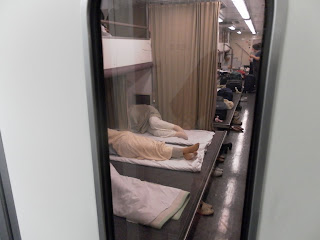
While some my find sleeping on a straw mat on the second story of a scary old Japanese farmhouse unusual accommodations, that's just another day living with Steve. In canvassing two major islands in this country, I've also had the chance to sleep in a church sanctuary and on a couch in a storage closet. Runner-up for most interesting sleeping arrangement was the night train I took to Hokkaido, the northernmost island of Japan.


But by far the most unusual has been in Sapporo, in the capsule hotel (yes, it's exactly what it sounds like). Always concerned with economizing space, the Japanese have found an accommodating solution. Why pay for a full-sized hotel room, when all you really wanted was the bed? It's only about 20 bucks a night, but I would have paid twice that much just for the experience.

Here's how it works:

There's no space for luggage, so put all your stuff in one of these (I had to really wrestle to get my big hiking bag in.)

Then change into a set of these bad boys. This is what you get to wear inside the building.
Next, go soak in the public bath (no photos here! Don't worry, it's males-only, and only awkward if you stop to think about it.)


Forget something? Everything you think you might need (and a few things you don't) is provided. Toothbrushes come with toothpaste already applied. Just add water!

Room service.


Nope, those aren't washing machines... That's your home for the night!


TVs come with headphones so you don't disturb your neighbors.


And good night!

Tuesday, June 22, 2010

Altars at Bethel


I recently had a conversation with my friend Sonoko about a sermon she had prepared on Genesis 35, Jacob's return to Bethel and the importance of place. Jacob had first passed through Bethel while running for his life from Esau. It was there that he saw the ladder ascending into heaven and made a somewhat self-serving vow to follow the Lord. His return to Bethel years later had some similarities--again there was an altar and a vision of God. Yet it is the differences that are more striking. Rather than all alone with nothing but his staff, he has great wealth, a large family, and many servants. Rather that fleeing for his life from Esau's wrath, he had reconciled with his brother, and come to settle his flocks. Rather than a first encounter with the Lord, he had come recognize and trust God's voice. Even his name was different. Bethel for him was a place for reflection on God's blessings, and rededication to his service (Gen. 35:2-4). And the place became so significant to his relationship with God, that the Lord even revealed himself as "the God of Bethel" (Gen. 31:13).

In some ways, Japan has become a sort of Bethel for me. When I left the first time, at the age of 13, I was merely beginning my discipleship. Each subsequent return marked a significant phase in my discipleship, and now I am at the point of making disciples of others. When I left Okayama four years ago, it was to receive more training. Now I am at the point of training others. God has provided in many ways. Visits to the river where I played as a boy or the place where I lived as a missionary have been like tiny altars scattered across the landscape of my discipleship.

Yet even a greater testimony to God's goodness has been the way in which the places themselves have changed. When I left Okayama four years ago, our church was meeting in a tiny room above a coffee shop. Now, what was then nothing but rice fields has become an attractive, two-story church building. I had tried to start a coffee ministry when I was there, but with little success. But now they convert the sanctuary into a fashionable cafe every weekend. The fact that a church can be both fashionable and welcoming has so surprised the Japanese public that our pastor was interviewed on local television by national celebrities as tasted the church's wares.

As I worshiped together with this growing congregation, my charge to them was to stay faithful. Yet I myself was reminded of how faithful God has been. He has brought me through many joys and hardships in the last four years alone. He has built me up in America while building up the Church in Japan. He has used me even in my absence, as several ladies in the church told me exactly what I had preached on over five years ago, and how it was still impacting them. From this altar of thanks I move forward with the flocks and herds I have to serve the Lord in other places yet.

Sunday, June 20, 2010

Happy Father's Day

Father's Day is actually a pretty big deal in Japan, at least in the shops. Another interesting cultural tidbit is that fruit makes a nice gift on any occasion. And it's not size or taste that counts, but appearance. A quick walk through a local department store reviewed the following fruits for Father's Day. I've included the prices for your convenience.
Box of Red Grapes (single cluster): $84


Box of Green Grapes (single cluster): $105


Single Red Mango: $105


Perhaps the sign says it best.


At these prices I'm afraid I can only afford a slice of eggplant for you, Dad. Hope you like the card at least. Happy Father's Day!

Thursday, June 17, 2010

A Rare Opportunity


As I travel up and the main island of Japan, I've been offering to help out in whatever ministries the friends I visit are involved in. Up until now, this has been limited to talking with church members, hanging out with youth, and occasionally giving my testimony. However, my friend Madoka's church takes their Bible studies very seriously, and right from the beginning I've had the opportunity to help out, not only with fellowship, but also teaching a Bible study and even teaching and encouraging some of the leaders. These opportunities come at most a day in advance, so I've been kept on my toes the whole time.

The most unexpected (and by far the most fun) opportunity was to teach Greek to the ladies' prayer group. This group of about 20 women meets weekly for prayer and a lengthy Bible study, and when they found out that a "Greek professor from America's finest Evangelical seminary" was in their midst, I was quickly recruited to come and join them. Madoka (also a Trinity grad) had taught some of them the alphabet and a few words during a summer camp a year or so ago, and apparently some of the ladies (and even several children) became quite enthusiastic about keeping up the study on their own. I was able to dig up a few of my old Greek handouts and translate them into Japanese, and together we translated a short passage from Greek into Japanese, and discussing the nuances and exegetical significance of the grammar. They all took this quite seriously, and you'll notice in the photo above that they even had me wear two microphones so that both the audio and video of this historic lecture could be preserved for the posterity of the church.


I'm thrilled to see a church that is so excited about God's word that they're willing to commit this much time and energy into study, and I encouraged them to keep up their study of the Bible, as well as of the Greek language. At the same time, I also discussed with them some of the theological implications of the New Testament's being written in Greek. Namely, that God spoke to real people in the everyday language of an actual era of history. Our God is a God who works in human history, and comes to us at our level. The curse of Babel, unlike the other punishments and curses in the Bible, is never undone. Rather, the various languages of the world are blessed at Pentecost and preserved even into eternity (Rev. 7:9). Though other religions require that we go to where God is, whether by good works or religious rites or even a change in culture and language, the heart of the gospel is just the opposite. Our God came to us where we are--actually in space time and history. He meets us as we are, and then from there, by the grace of the cross, he transforms us into what we ought to be. Thus, even the study of Greek reminds us of the kind of God we worship--one who translated himself into flesh to dwell among us--and of the privilege we have of worshiping him in our mother tongues for all eternity.

Tuesday, June 15, 2010

Mr. Shimoyama, and other encounters with grace


Of the many people and places I was hoping to visit, one of the non-negotiables was a tiny shop, not much bigger than some walk-in closets, crammed between an octopus stand and an antique store in the rural town of Okayama. Barrels of coffee beans line either side, making it almost impossible to enter, let alone move around. I stumbled across Shimoyama-san's coffee shop when I got lost one day when I lived in Okayama, but I soon became a regular customer. Despite the language barrier at the time, he and I became fast friends through our shared love of good coffee. As my Japanese abilities increased, we began to discuss coffee, philosophy, politics, and religion over a cup or two as he custom-roasted some of the best coffee beans I've found anywhere in the world. I've had the opportunity to share the gospel with him piecemeal over my two years in Okayama, but it still hasn't quite sunk in yet. However, I had become quite close to him and his family, and we had even kept in touch somewhat over the last four years I've been at Trinity.

I wasn't able to contact Shimoyama-san to let him know that I was in Japan, so I decided to just walk into his shop instead. The look on his face was priceless as midway through his welcome he realized who I was. We enjoyed several cups of coffee together as he roasted my usual order and caught up over the past four years. Because of the heavy rain (rainy season just started), there were hardly any customers, so we were able to talk for quite a long time. Right in the middle of the conversation he asked me a question that lead into a full-blown explanation of the gospel from start to finish. Knowing that my time here is so limited, I was thrilled to have the chance to share my faith clearly one more time. I'm certain that he understood it. I'll be having dinner with him and his family this Saturday, so please pray for this next encounter.

Before I left the shop, I asked for some of the chaff left over from roasting the beans (the roasting process produces a lot of chaff), to use as a visual aid for the lesson I was preparing to teach the high school students at Madoka's church. The lesson is on Psalm 1, which says that the wicked are blown away like chaff, in contrast to the tree planted by streams of water, which stands firm. This afforded the opportunity to briefly share this Psalm with him as well.

I left the shop, exuding gratitude and the smell of coffee, and as the rain grew worse, I found a bench under an awning to sit and work on my lesson. However, before to long a woman approached me and asked what I was reading. I said it was a Bible and to my surprise, rather than being scared off, she sat down and asked me what it said. I read her Psalm 1, and she told me it brought tears to her eyes. We talked for a while about this Psalm and about the gospel. She was very moved, and told me that today was her birthday, and that she thought God must have sent me to meet her.

Bible study with the youth group went very well tonight (they loved the illustration of the chaff), and I had the chance to encourage some others in their study of the Bible after that. But what sticks out to me most at the end of the day is how well today's encounters illustrate the main point of my lesson from Psalm 1--that all of us have chosen to walk in the way of the wicked, and that it is by the grace of Jesus Christ alone that we are not only set on the path of the righteous again, but also made to bear fruit. God used the rain and other coincidences to direct my path to these chance encounters, and though I have little to offer on my own, he has given me a profound and powerfully moving story--the story of his gospel--to share with all who ask. Somehow he transformed this less-than-worthless chaff into a deeply rooted tree, and I am grateful to be the one through whom he chose to work today.